

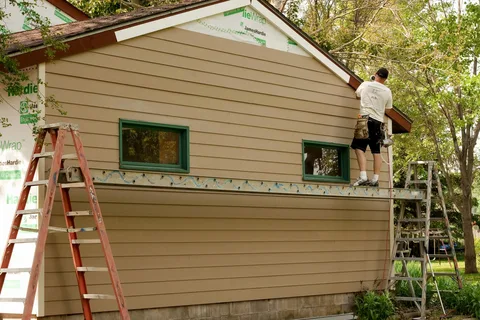
Hardie Board Siding Installation Calgary: Complete Guide
Hardie board plank siding is fiber-cement cladding manufactured by James Hardie, engineered from cement, sand, and cellulose fibers to resist cracking, warping, rot, and pest damage. For Calgary homeowners, this composition matters more than the marketing language around it, because Alberta’s climate cycles between hard freezes, chinook thaws, hailstorms, and intense summer UV exposure within the same season. A siding material has to survive all four conditions without losing its seal or its finish, and Hardie plank is built specifically for that kind of exposure.
What Makes Hardie Board Different From Vinyl or Wood Siding
The core difference is composition, not just appearance. Vinyl siding is a petroleum-based plastic that becomes brittle in cold temperatures and can crack on impact from hail, a common Calgary weather event. Wood siding absorbs moisture, which leads to rot, insect damage, and repeated repainting. Hardie board, by contrast, is non-combustible, dimensionally stable across temperature swings, and holds factory-applied ColorPlus finishes that resist fading far longer than field-applied paint. Homeowners comparing options for their exterior often review our vinyl siding services alongside Hardie board to weigh upfront cost against long-term durability, since the two materials solve different budget and performance priorities.
The Hardie Board Product Line and Where Each Type Is Used
“Hardie board” is a category, not a single product, and the specific type installed changes the result on a home.
- HardiePlank lap siding is the horizontal board most people picture when they think of traditional siding, and it forms the primary wall covering on most Calgary installations.
- HardiePanel vertical siding creates clean architectural lines and is typically used on gables, accent walls, or modern builds.
- HardieShingle siding replicates the staggered look of cedar shingles without the maintenance wood requires.
- HardieTrim boards finish the edges around windows, doors, corners, and columns, sealing the vulnerable transition points where water intrusion most often starts.
Each of these products is frequently paired with related exterior work. Trim and siding installers commonly coordinate with soffit and fascia upgrades, since both systems meet at the roofline and need to be sealed together for proper moisture control and attic ventilation.
The Installation Process and Why Sequencing Matters
Correct Hardie board installation follows a specific sequence: removal of old siding, inspection of the sheathing for rot or damage, installation of a weather-resistant barrier and moisture flashing, then the boards themselves, fastened according to James Hardie’s nailing and clearance specifications. Skipping the moisture barrier step, or fastening boards too tightly against trim, is the most common cause of premature failure, regardless of how good the siding material itself is. Because siding installation opens up the building envelope, it’s also the point at which many homeowners address adjacent exterior needs at the same time, such as window replacement around openings that will be re-flashed anyway, or drainage upgrades through gutter installation to keep water moving away from the new cladding.
Hardie Board Siding Cost in Calgary
Hardie board costs more per square foot than vinyl, and installation labor costs more too, since fiber cement is heavier and requires specialized cutting tools and fastening technique. The final price on a given home depends on square footage, the mix of plank, panel, shingle, and trim products used, the condition of the existing wall sheathing, and how much trim detail the design calls for around windows, corners, and columns. Because it’s a 30-to-50-year material when installed correctly, the relevant comparison isn’t the sticker price against vinyl, it’s the cost per year of ownership, factoring in vinyl’s shorter lifespan and higher repaint or replacement frequency.
Maintenance and Long-Term Performance
Once installed, Hardie board requires minimal upkeep: an annual rinse to remove dust and debris, periodic caulking checks at trim joints, and visual inspection after major hailstorms. It does not need repainting on the same cycle as wood siding, since the ColorPlus finish is baked on at the factory rather than applied on site. Homeowners looking to complete the exterior update sometimes add architectural panels as accent material alongside Hardie plank, combining the two for a mixed-material facade that’s common on newer Calgary builds.
Getting Started
Hardie board plank siding is a durable, low-maintenance option built for Calgary’s weather swings, but the outcome depends heavily on correct installation, not just product selection. Homeowners ready to move forward can request a free inspection and quote to get an accurate scope and cost for their specific home.
